Article: Leather Craftsmanship: What Time Leaves Behind | Cordiz
Leather Craftsmanship: What Time Leaves Behind | Cordiz
What Time Leaves Behind
Some women take time as their material. They learn slowly, look for a long while, and let what they make, or who they are, reveal itself without haste. They accept that the material keeps the trace of the gesture, that time reveals. At Cordiz, a leather goods house whose workshop has been based in the Tarn since 1982, we find six such women, each breathing a little of her personality into every creation. Six ways of being, living and creating that inspire the world of Cordiz.
Eileen Gray
A white house set on the rocks, facing the sea. Eileen Gray designed it, built it, lived in it, and for decades, others put their names to it in her place. She loves the way she works: freely, boldly, discreetly. Time eventually gave her back her name. It always returns what we entrust to it.
“A house is not a machine for living in. It is the shell of man, his extension, his spiritual emanation.” Eileen Gray, L’Architecture vivante, 1929
Simone Weil
With the agrégation in philosophy at twenty-two, Simone Weil might never have left her books. She chooses the factory, then the vineyards, to feel with her own hands what others live through. To think, for her, is first to put herself in another’s place. She comes away with one certainty: nothing is done well without attention. In an artisan workshop, attention can be felt, in a seam that holds, in a smoothed edge, in the details that shape our leather goods.
“Attention is the rarest and purest form of generosity.” Simone Weil, letter to Joë Bousquet, 1942
Elsa Peretti
A bean, a drop of water, a bone. What others overlook, Elsa Peretti looks at long enough to keep its truest form. She does not adorn nature; she distils it. Her jewels are touched before they are seen. The cuff follows the bone of the wrist, the bean rests in the palm like a pebble polished by the tides. In her hands, the ordinary becomes precious without losing any of its simplicity. At Cordiz, it is this way of seeing that guides the making of each of our leather bags.
“Style is to be simple.” Elsa Peretti, WWD, 1976
Georgia O’Keeffe
Georgia O’Keeffe chooses the desert for its isolation and its harsh light. Where other artists live in colonies, she keeps to herself, and nothing distracts her. She gathers bleached bones and leather-coloured stones, and paints a bare mountain she calls her own, summer after summer, until she settles there for good. Her eye sharpens, and under her brush the barest earth becomes petal. This is how a craft is born: from a place, from time, and from the same gesture repeated until it rings true.
“To see takes time, like to have a friend takes time.” Georgia O’Keeffe, 1939
Peggy Kuiper
They look at us without letting themselves be seen. The women painted by Dutch artist Peggy Kuiper are naked and masked, enigmatic, a little wild: portraits of memories more than of models. She paints them by instinct, the way a child draws, before learning what is beautiful. She works in layers, erasing, covering over; beneath each face, other faces wait. There is something primal here, a knowledge of the body that knows before it understands. Leather holds that same knowledge: it takes on a patina with every season.
“[My painting] tells a truth that can only be felt.” Peggy Kuiper, 1605 Magazine
Virginia Woolf
A hand press, set up in a dining room. In 1917, Virginia Woolf equips herself to print her own books: no one will ever again decide for her what she may publish. She prints what unsettles, her own depths turned into fiction, the cause of women defended without caution. To write, she says, one must first kill “the Angel in the House”, the docile, perfect wife expected of her. A woman needs money and a room of her own. Not permission. A handbag has something of that room: it holds what concerns no one but oneself.
“Lock up your libraries if you like; but there is no gate, no lock, no bolt that you can set upon the freedom of my mind.” Virginia Woolf, A Room of One’s Own, 1929
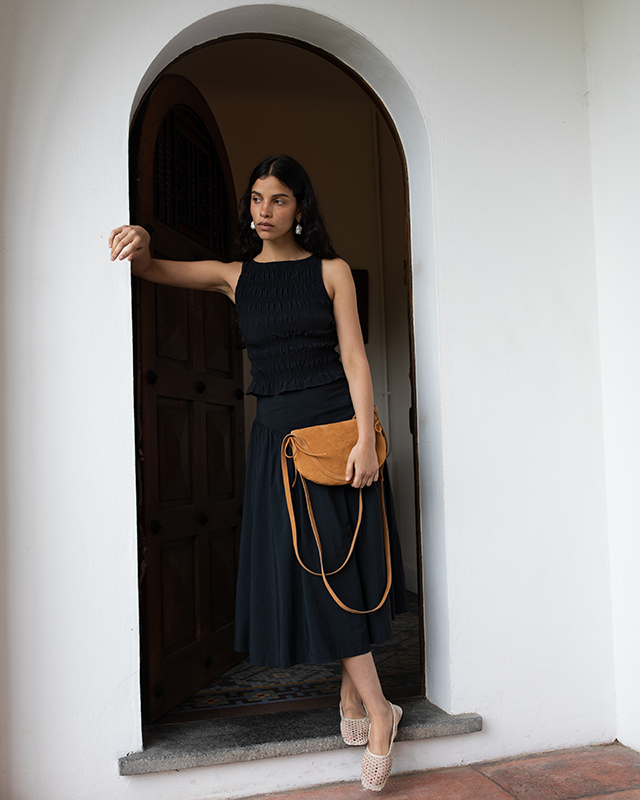
At Cordiz, we believe an object does not lie. It keeps the trace of the hand that made it, and of the time it was given. The women who inspire Marina Dias, founder of the house, are made of that same material: none of them seeks to appear, all of them have found a way of being.
From them, the house keeps a way of looking long before choosing, of creating without hurry, of living without asking permission. The woman who carries Cordiz resembles them a little. The rest is left by time, on leather that softens into patina and on the story each woman slips inside.
Since the brand was founded in 1988, every Cordiz bag has been made in the family workshop in Graulhet, carrying that same essence.